
Web and Social Media
This was another aspect of media that I really didn't fully involve myself in until I was in Online News. I have spent a lot of my senior year familiarizing myself with how to best reach our students and audience through social media in order to engage them in what we are producing.
Building a Platform
I knew our generation was addicted to their screens, but I didn’t think we could use it to our advantage.
With teenagers spending as much time online as they do, the biggest platform to gain their attention is social media. We quickly learned that if we wanted students to engage with our
content, we had to engage them on social media first.
When we first created our social media show for broadcast, it had our show intro, which was a very long intro for social media. Most students weren’t going to wait around to watch the entire video if they had to sit through that, which is something that we learned later on.
To gain their attention, we made sure to post consistently and cater to them. When choosing songs to go with reels, I make sure they are popular so that they are something everyone can enjoy. We created fun marketing reels in between to keep students engaged on our profile. Recently, we hit a goal of 2,000 followers on instagram.
Drawing our audience’s attention through what they are familiar with is what will get them to start coming to our content willingly.
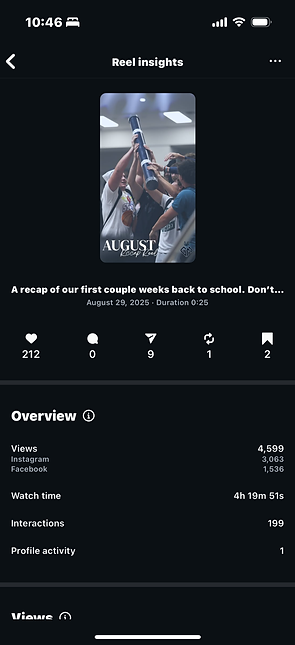

This year, I had the idea of starting monthly recap reels for all the events that were the highlight of the month or the best pictures from that month. This was a strategy not only to get more followers but also to keep the student body engaged in the content we were producing. I made sure that the recap reel was posted within the next few days after the month ended. I also tried to choose songs that would resonate with that month or with the student body. For example, in October I used "Thriller" by Michael Jackson and in January I used "I just might," which was Bruno Mars' latest song.
Click to view the reel from each month. (Since we were out for most of December, there weren't enough of a variety of photos to create a reel).
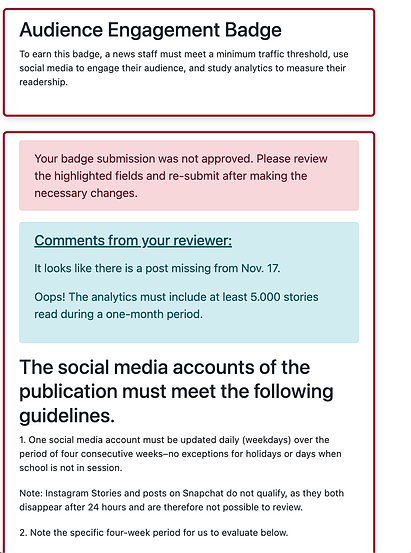
Earlier in the year, we had tried to get our audience engagement badge in SNO, but we didn’t realize we missed a day and didn’t get enough of our stories read. When trying again in February, I made us plan out our first week and what we were going to post each day in order to ensure we don’t make another mistake like that. (Everything in the orange is what we had planned out at that point).


Freshman year, our group of broadcast 1 students had created the outline for a social media “show,” and we called it HTN Early Bird. It would feature a few announcements for the week and a small mini package.
On the right is an example of when I tried to elevate the show. We had been filming our anchor portion from our phones because it was the easier option, and the aspect ratio was perfect for Instagram. However, instead of using my phone, I had used a 50mm lens elevating the look of the show a little bit. It also meant I had to memorize my script last-minute, since on our phones we had a teleprompter app.
On the left is an example of how we were able to adapt to whatever was thrown at us. Due to ice, school had been cancelled, but we were determined to put out our weekly post. I wasn't on cycle to report for Early Bird that week, but I quickly volunteered to step in and edit together the reel for that week.

One of the biggest things that I contributed to the newspaper site, which wasn't there before, was a form of multimedia. With every feature I did, I made sure to put out a video package along with it. The article would dive into the more technical aspect of the feature, while the video might explore fun facts or information that I wanted to share but didn't necessarily fit in the article. For example, with the article on the right, I focused on how Ava started her business but through the video package, I was able to ask her fun questions, such as what her favorite banners are.

